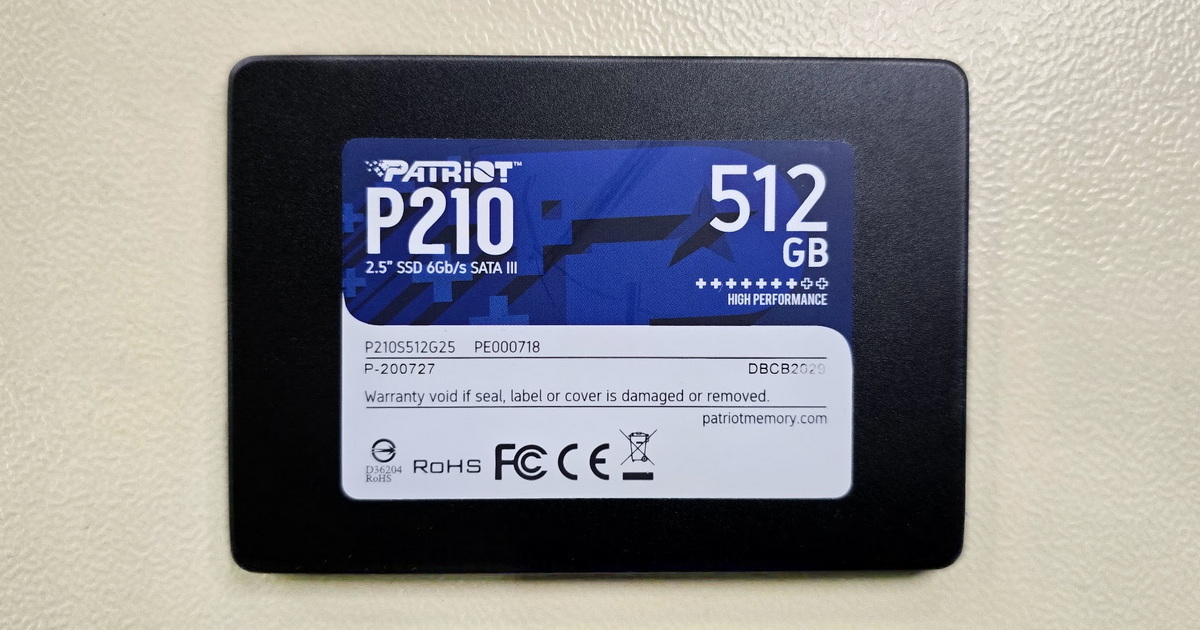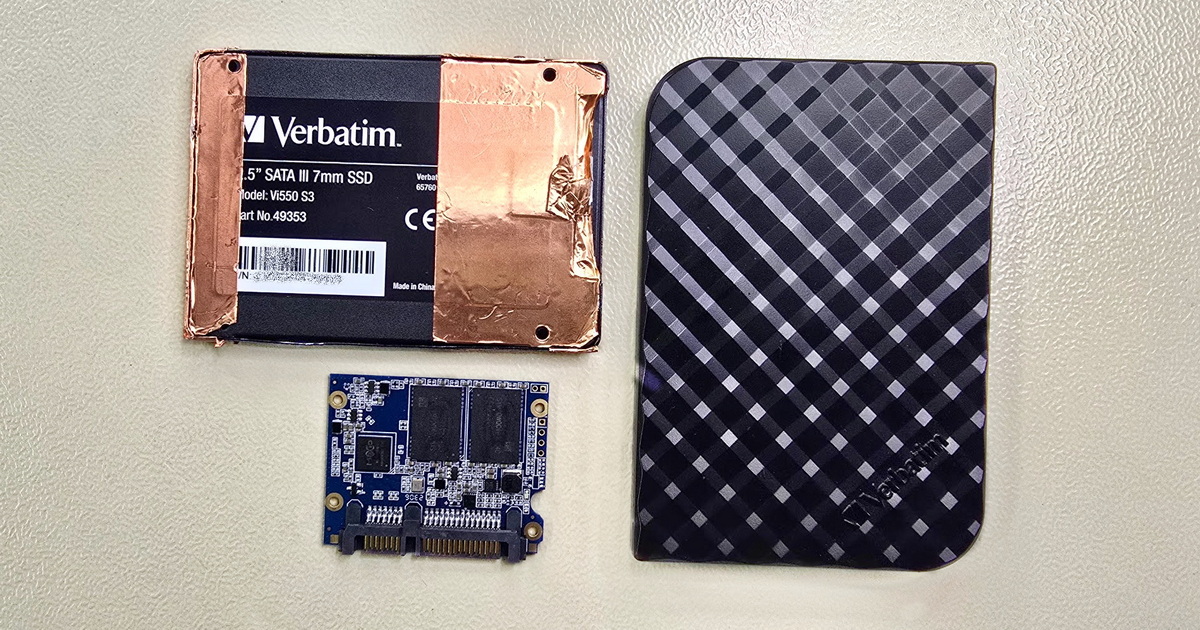
Verbatim is one of those brands that doesn't actually manufacture its own products. They source complete solutions from various OEM suppliers and put their own logo on them. With external SSDs, this means that behind the sleek enclosure you can find practically anything. In this case, after opening the device, we found a USB-to-SATA bridge and behind it a standard 2.5" SATA SSD – the Verbatim Vi550 S3 – with a Maxio MAS1102B controller.
Multi-sourced SSDs and why this matters for data recovery
The Verbatim Vi550 S3 is a textbook example of a multi-sourced SSD: the same model, sold under the same designation, can contain completely different controllers and different NAND flash depending on the production batch. We most often see this model with a Phison PS3111-S11T controller, occasionally with Silicon Motion, and – as this case demonstrated – sometimes with a Maxio MAS1102B. Verbatim doesn't disclose the specific configuration in the datasheet, and the customer has no way of telling what's inside their drive before opening it.
For everyday use, this makes no difference – all variants meet the advertised specifications. For data recovery, it makes all the difference in the world. Every controller requires a different approach, different tools, and different procedures. The diagnostic and recovery workflows are fundamentally different.
Maxio: affordable, but a headache for data recovery
Maxio Technology – formerly sold under the Maxiotek brand, and today known mainly as Maxio – produces affordable SATA and NVMe controllers. You'll find them in SSDs from brands like ADATA, Patriot, Hikvision, Apacer, Lexar, KingSpec and Silicon Power. For normal use they're perfectly reliable, but for data recovery they're among the most challenging controllers in the field. None of the major commercial data recovery tools – PC-3000, MRT or DFL – currently offers full support for the entire Maxio family. Some older models are partially supported, others are still officially marked as "under development" in PC-3000, and for the newest NVMe variants only a basic Techno Mode is available.
The MAS1102B specifically is a two-channel DRAMless SATA controller – a budget chip designed for entry-level SSDs. When a controller of this type experiences firmware or translator failure, its behaviour is hard to predict, and recovering data from a specific model often calls for an individual approach, custom tools, and procedures that go well beyond the standard workflow.
Traces that prove nothing
During the visual inspection of the PCB, we noticed traces of hot-air soldering. It could have been a remnant of service work done at the previous lab – but it could just as easily have been residue from the factory, left behind by inadequate flux cleaning, which isn't unusual on cheaper OEM boards. The client couldn't confirm or rule out how the drive had behaved before its first diagnostic visit, so the original condition remained an open question. We didn't find a definitive answer in this case.
When the standard approach isn't enough
Connected to the PC-3000 Portable PRO, the SSD gave no response. It wouldn't identify, it wouldn't report anything about itself. Even shorting the service points to force safe mode did nothing.
When this happens, there's only one path forward: a detailed analysis of the electronics down to the level of individual components and signal paths. After carefully studying the PCB layout and the controller's behaviour, we made targeted hardware modifications to the board, with precise interventions in the SSD's power supply and communication circuits. This isn't the kind of procedure you can describe as "replacing a part" – it requires a deep understanding of the specific controller's architecture and how it talks to the NAND flash.
After these modifications, the drive finally came to life and started communicating.
Weeks of work and hundreds of manual interventions
Creating the binary image turned out to be a long haul in itself. The drive was communicating, but reading was slow and unstable. The LBA map filled up gradually, with plenty of problematic areas that required repeated passes with adjusted parameters.
The whole recovery took several weeks and demanded a great deal of hands-on work – manual adjustments to timeout settings, repeated corrections of error areas, constant monitoring of stability. An automated process wouldn't have worked here; the drive would either have stopped responding altogether or deteriorated further during the long read.
Device: Verbatim Store 'n' Go (1 TB external SSD)
Internal drive: Verbatim Vi550 S3 (2.5" SATA)
Controller: Maxio MAS1102B (two-channel DRAMless SATA)
File system: exFAT
Problem: SSD failed to identify, no response even in safe mode
Solution: Hardware PCB modifications, long-term imaging with manual corrections
Result: 87,721 out of 87,924 files recovered completely (244 GB), 199 files partially damaged
From what was effectively a dead SSD, we managed to recover the vast majority of the data. Out of 87,924 files in 2,587 folders, 87,721 files – 244 GB in total – were extracted completely intact. For the remaining 199 files, parts of their content lie in defective areas that couldn't be fully read even after multiple passes. For a drive that gave no response when connected and had already been through diagnostics elsewhere, that's a result we're very happy with.
What's the takeaway here? If you've been quoted a high price and a long turnaround with an uncertain outcome somewhere, it doesn't necessarily mean your case is hopeless. Sometimes it just means that particular lab has hit the limits of what it can do – and those limits vary significantly from one lab to another. For more on SSD failure and recovery options, see our section SSD failure – causes and recovery options. If you're currently deciding what to do with a non-functional SSD, feel free to take advantage of our free consultation and diagnostics.
Technical terms in more detail
Multi-sourced SSD – an SSD sold under a single model designation but containing components (controller, NAND flash) from different suppliers depending on the current production batch. Typical of brands that don't manufacture SSDs themselves, but buy complete solutions from various OEM suppliers. The manufacturer usually declares only performance specifications, not the specific hardware configuration.
DRAMless controller – an SSD controller without external DRAM for the mapping table (FTL). Instead of dedicated DRAM, it uses either an internal SRAM cache or part of the host system's memory (Host Memory Buffer, in the case of NVMe). The mapping table itself is always stored in NAND flash; the difference is in how the controller accesses it during normal operation. DRAMless controllers are cheaper and are used in budget SSDs.
Safe mode (factory mode) – a service mode in which the SSD controller starts up without loading firmware from NAND flash. It's triggered by shorting specific points on the PCB and is used for diagnostics and access to service functions on drives with damaged firmware or a damaged translator.
Translator (FTL – Flash Translation Layer) – the internal mechanism of an SSD that maps logical addresses (LBAs) visible to the operating system onto physical locations of data in NAND flash. A damaged translator is one of the most common causes of data becoming inaccessible on an SSD – the data is physically still there, but the drive "doesn't know" where.
Binary image – a sector-by-sector copy of the entire medium, including damaged areas. Unlike standard file copying, it captures a complete image of the drive, from which the file system can be reconstructed even if it's partially damaged.